Austria
 Belgium
 BosniaAndHerzegovina
 Bulgaria
 Croatia
 Czechia
 Estonia
 France
 Germany
 Hungary
 Ireland
 Italy
Italy
 Latvia
 Lithuania
 Luxembourg
 Netherlands
 Poland
 Portugal
 Romania
 Serbia
 Slovakia
 Slovenia
 Spain
Spain
 Swiss
Swiss
 Ukraine
 United Kingdom
 Australia
 China
China
 Georgia
 India
India
 Kazakhstan
 Singapore
 Thailand
 Turkey
 الإمارات العربيّة المتّحدة
 South Africa
 Canada
 Mexico
 USA
USA
 Brazil
 Chile
Chile
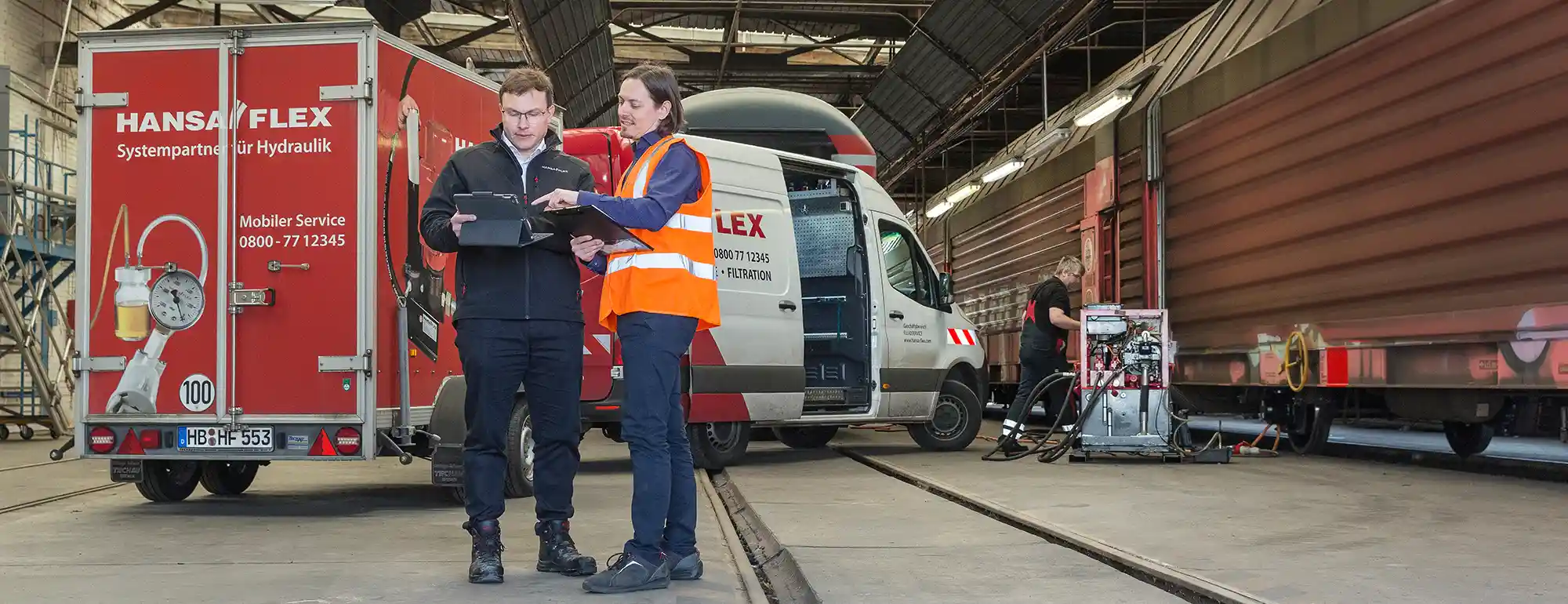
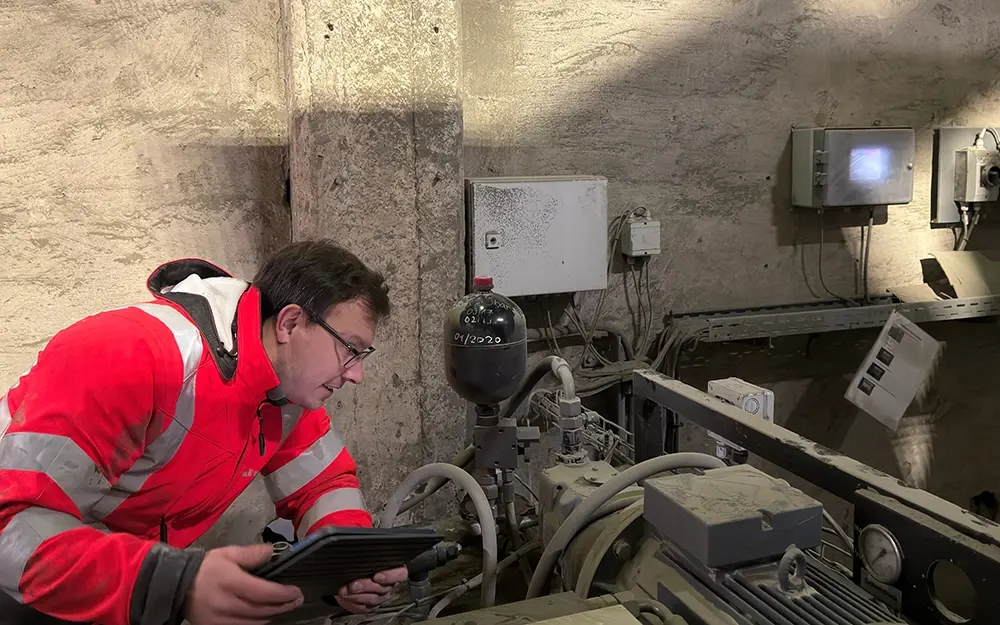
Originally, Felix Marschner had wanted nothing at all to do with hydraulics. Today, the 38-year-old heads the Fluid Service team and looks back on a remarkable career at HANSA‑FLEX. During his training, he was already showing a strong interest in how technology works and practical problem-solving. His first encounters with hydraulics in the industrial field were almost inevitable. “I quickly saw that no sector of industry could function without hydraulics. The interplay with automation, control and fluid technology fascinated me from the beginning,” recalls Marschner. After a few jobs in industry – not only in Germany, but abroad as well – he joined HANSA‑FLEX as installation manager in the Industrial Service for eastern Germany. His ability to see how things work and come up with holistic solutions did not go unnoticed. In order to deepen his broad practical knowledge with the related theory, he successfully completed the advanced qualification as hydraulics specialist at the International Hydraulics Academy (IHA). “Training and professional development play a key role at HANSA‑FLEX. I’m very thankful to my supervisor at the time, Ronny Becker, for recommending me for this course and for his active support in my professional development.”
No walk in the park: the qualification for hydraulics specialist
Despite his extensive practical experience, the depth of study for the advanced qualification for hydraulics specialist at the International Hydraulics Academy (IHA) meant Marschner could not afford to take things easy. “It was never only about the ‘what’, but always also about the ‘how’,” recalled Marschner. Instead of knowing only that a lowering brake valve holds a load, the course participants were expected to analyse and calculate how the physics of pressure settings, ratios of areas, forces and other factors determine the opening point. Hydraulics lecturers provided countless aha moments: “It was as if all those loose ends from years of practical experience suddenly joined themselves together to form a logical picture.” The rhythm of the course – one week at the Academy in Dresden, three weeks back at work – proved to be a factor in its success. “This alternation is worth its weight in gold. Participants can review the theoretical knowledge they learned on the course in the context of a real hydraulic system, and, vice versa, they can raise questions in the lecture room arising from their work.” Another plus point: trainers and participants from a wide range of industries are able to exchange opinions on an equal footing. This creates a valuable network, from which Marschner still benefits today.

Crucial milestone
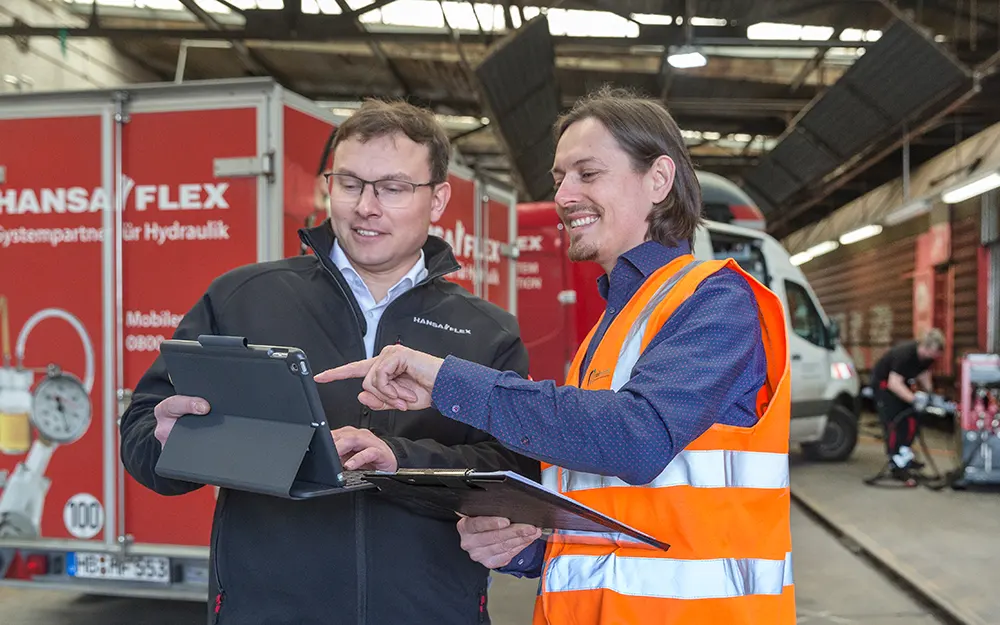
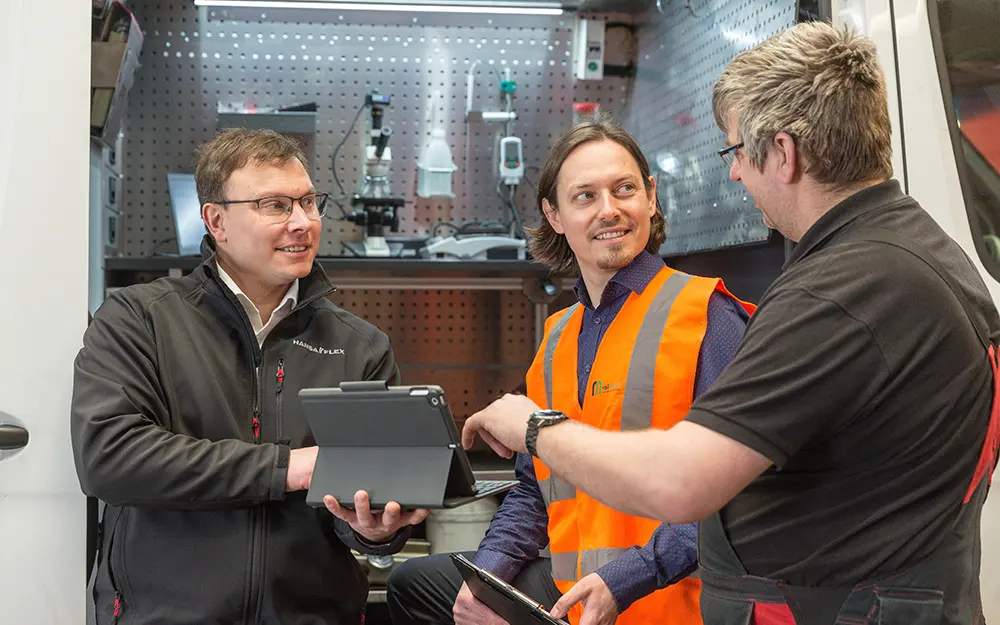
The advanced qualification as hydraulics specialist at the International Hydraulics Academy (IHA) means much more to Marschner than just another qualification on his CV: “People who are successful in gaining this challenging advanced qualification as hydraulics specialist are more confident with customers, more solution-orientated in their recommendations and take a more comprehensive view of systems and their modes of failure.” For his own career path, the advanced qualification opened the door to further specialisations. After completing the advanced qualification, Marschner moved over to HANSA‑FLEX Fluid Service. Further professional development courses at the Hydraulics Academy and from other providers intensified his knowledge in the field of fluid technology and particularly in oil analyses. It was not long until Marschner became a system technician in the Fluid Service and took on additional responsibilities as Deputy Team Leader. In January 2024, Felix Marschner was finally promoted to Fluid Service Manager. The logical step in a career profile shaped by continuous professional development.
Causes not symptoms
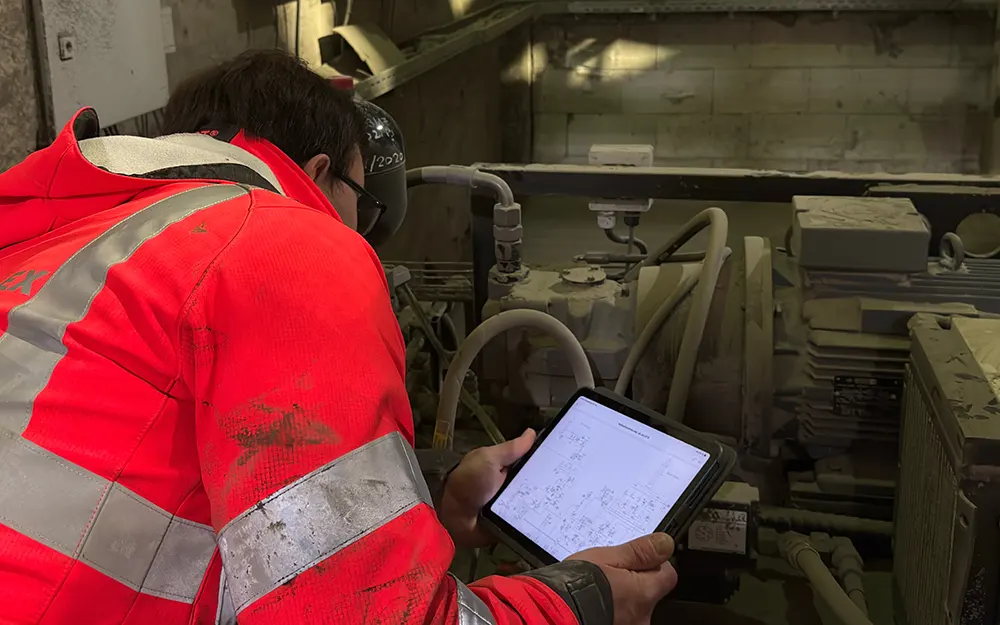
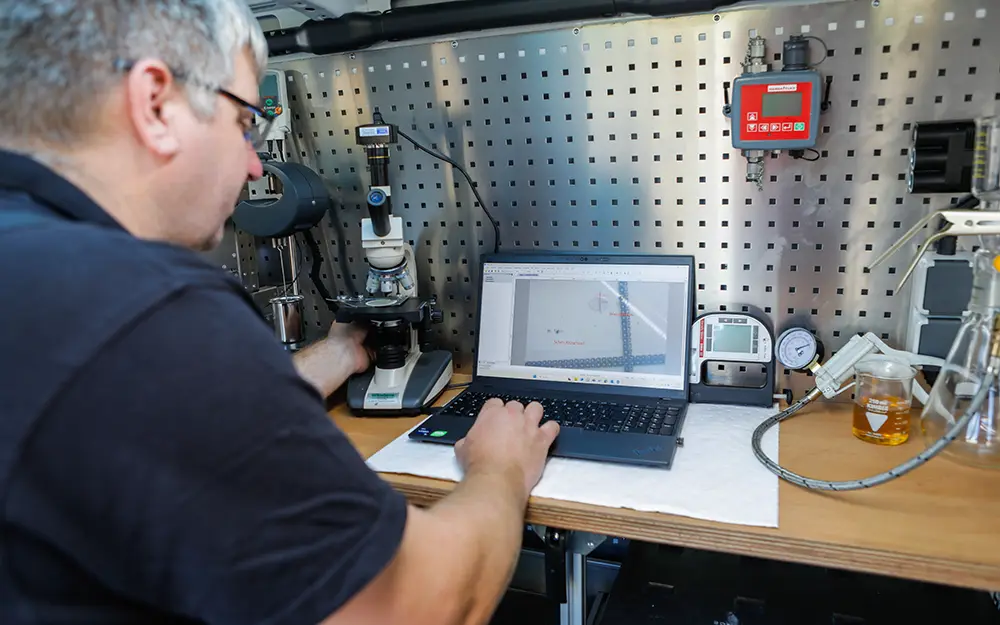
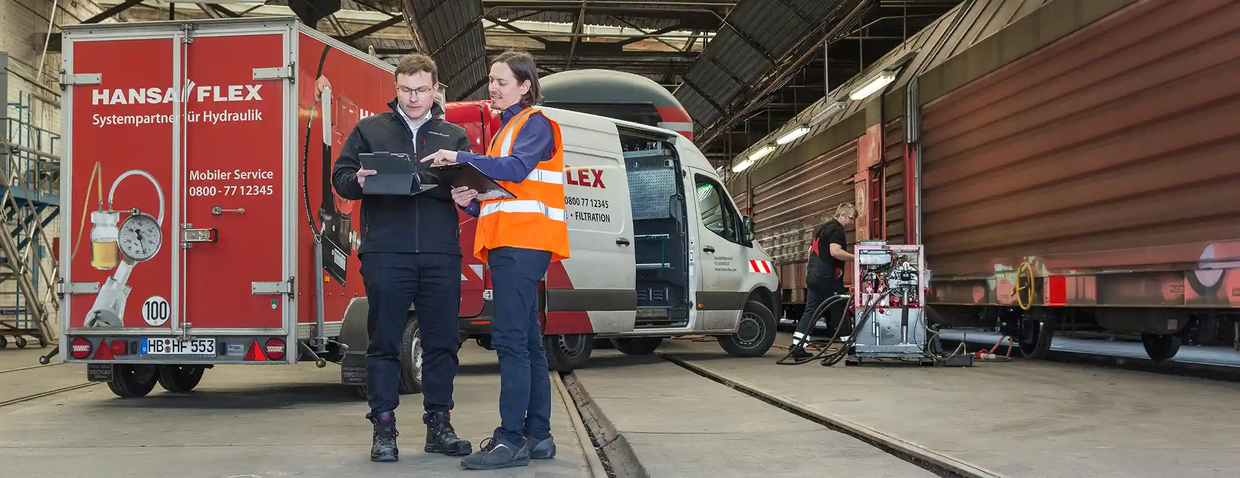
The Fluid Service is among the most challenging areas of hydraulics. It demands a deep understanding of many aspects from individual components to fluids and complete hydraulic plants. In addition, there is also the need to address issues concerning safety, energy efficiency and system optimisation. “The knowledge I gained in these professional development courses allows me to deal with the causes of problems, not the symptoms,” explains Marschner and illustrates this with a clear example. A customer is complaining about some hydraulic pumps continually failing. While others may have simply replaced the pumps, the hydraulics and fluid specialist first did a few calculations. “With the knowledge from the advanced qualification as hydraulics specialist, I can now exactly determine whether a suction line has been incorrectly sized. If the nominal diameter is too small, air is released from the oil, the pump suffers cavitation and eventually stops working. This can be demonstrated in black-and-white to the customer in my calculations.”
Driving licence for hydraulics
When asked what advice he would give to a young hydraulics technician, Marschner gave a nuanced response. He recommends the advanced qualification for hydraulics specialist to everyone who wishes to progress in the industry. However, he warns against being overzealous: “Personally, I would not immediately apply for this course. I would first attend a few basic seminars on hydraulics while picking up some practical experience. A future career as a hydraulics specialist is much better built on this kind of foundation,” says Marschner. The Fluid Service Manager says this because it is precisely the linking of theory and practice that makes his daily work so stimulating. Marschner believes the advanced qualification for hydraulics specialist from the International Hydraulics Academy (IHA) should be prerequisite in the HANSA‑FLEX Fluid Service and in other parts of the company. However, he also believes it is just as important for a freshly qualified hydraulics specialist to obtain plenty of practical experience immediately, for example in the Industrial Service or the Fluid Service at HANSA‑FLEX. “The hydraulics specialist qualification is like a driving licence: you are given the knowledge, but acquiring the driving skills, i.e. picking up experience, is something you must do for yourself afterwards. You must never stop putting your knowledge to use in practice, otherwise you will become out of touch with hydraulics,” concludes Marschner.