Austria
 Belgium
 BosniaAndHerzegovina
 Bulgaria
 Croatia
 Czechia
 Estonia
 France
 Germany
 Hungary
 Ireland
 Italy
Italy
 Latvia
 Lithuania
 Luxembourg
 Netherlands
 Poland
 Portugal
 Romania
 Serbia
 Slovakia
 Slovenia
 Spain
Spain
 Swiss
Swiss
 Ukraine
 United Kingdom
 Australia
 China
China
 Georgia
 India
India
 Kazakhstan
 Singapore
 Thailand
 Turkey
 الإمارات العربيّة المتّحدة
 South Africa
 Canada
 Mexico
 USA
USA
 Brazil
 Chile
Chile
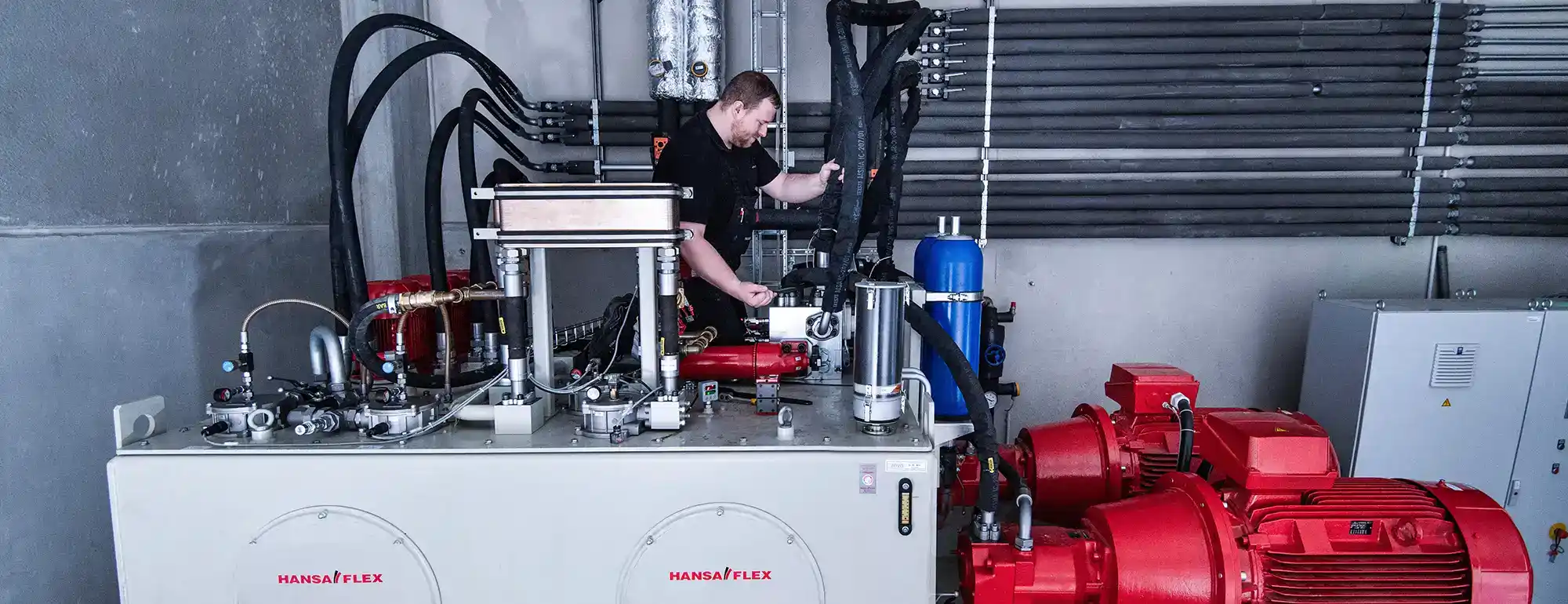
In hydraulic systems, performance is not determined by the individual component but by the weakest component. Pipelines with greater wall thicknesses or made from better material can be approved for higher pressures. However, if other components such as screw fittings, seals, valves or hose lines are not appropriately designed, they limit the performance of the whole hydraulic system.
Maxim
By taking pressure measurements, you can detect weak points before they lead to failures. For a pressure measurement, a precise knowledge of the allowable pressures of the individual components of the hydraulic system is indispensable. You can find allowable pressures, for example, in datasheets, catalogues or in the documentation supplied with the machine. You should also be aware of the system pressure and the allowable maximum pressure of the machine during operation.
For precise pressure measurements, HANSA‑FLEX offers digital measuring devices and sets such as the HK MH 2025. These instruments give clear measured values directly at the machine and are ideal for mobile use. The HANSA‑FLEX range contains other digital and analogue measuring technology for various applications.
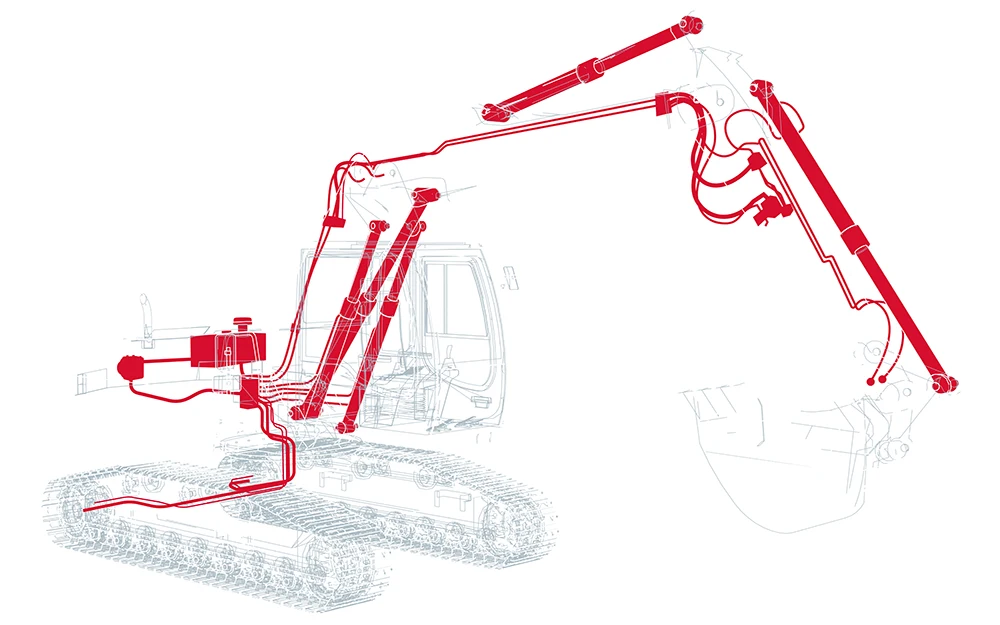
Step-by-step: this is how you carry out a pressure measurement
Important: any work on hydraulic systems or their components may be carried out only by suitably qualified specialist personnel and in strict observance of all the relevant safety regulations!
Preparation:
- Ensure the system is free of pressure and voltage, observe safety precautions.
- Select the measuring points (e.g. critical lines, near the pump, before valves, after cylinder connections).
- Take into account the guidelines in the operating instructions or manual.
Assemble the measuring devices:
- Prepare the measuring equipment, connect the digital or analogue measuring equipment.
- Correctly install all the measuring devices in accordance with the manufacturer’s instructions.
- Go through the HOW TO checklist if you are using a glycerine-filled pressure gauge.
Observe the maximum pressure value for pressure gauges
Pressure gauges display a specific pressure range. In other words: not every pressure gauge is suitable for every pressure range. Therefore the maximum pressure value must be known in order to avoid damage to the instrument or the hydraulic system.
- Know the full scale value
Check the full scale value of the pressure gauge. It defines the mechanical resilience; the displayed maximum pressure may not be exceeded. When selecting the measuring range: always allow approximately 30 % above the normal working pressure to cover pressure peaks. - System pressure is determinant
The maximum working pressure of the system determines the selected measuring range. The pressure gauge must be set above the anticipated pressure, otherwise the tube spring could be deformed. - Limit permanent working pressure (rule: 75–80 % of the full scale value)
For continuous operation: the normal working pressure should be a maximum of 80 % of the full scale value. - Take into account pulsations & vibrations
In the case of strongly pulsating pressures (e.g. pump outlets), glycerine-filled pressure gauges are used because the dampening effect protects the mechanism. - Glycerine filling: protects the gauge mechanism from vibrations, but does not change the mechanical resilience, the maximum pressure limit is still relevant.
- Inspect regularly: perform visual inspections for damage, discrepancies, or leaks at the pressure gauge.
Tip: if in any doubt, always take into account the manufacturer’s information about permanent pressure load and allowable peaks.
Performing pressure measurements:
- Slowly bring the system up to working pressure. Only operating cycles under real conditions lead to clarity and a promise of usable results!
- Note the values at all the measuring points.
- Use the design values from the manual or operating instructions for the machine as a reference.
Analysis:
- Compare the measured values with the design values (nominal and maximum pressures).
- Identify anomalies: pressure drops, peaks/overpressure, different values between similar lines, which could indicate uneven pressure distribution in the system.
Measures:
- Check weak components and eliminate deficiencies if necessary.
- Give us a call: working with our technical advisers, we identify weak points and recommend suitable products with the required properties.
- Specify maintenance intervals or replacement in accordance with the guidance in the manual.
Think about the system, not individual components
A machine can operate safely only if the components of the hydraulic system are approved for the required pressure.
For weak points to be detected early, we recommend considering pressure in relation to the whole system during the design, development and prototype construction and not to think only about individual components in isolation. This applies especially to complex hydraulic systems, such as those found in plant engineering or vehicle production.
Pressure measurement is one of the most straightforward diagnosis tools in hydraulics. Using portable measuring instruments, systems can be quickly checked and typical problems detected at an early stage. Pressure peaks, valve malfunctions or abnormal load cycles occur suddenly. Pressure measurement allows you to identify faults before they lead to breakdowns. Operational safety improves and unplanned stoppages can be consciously avoided.
This is particularly worthwhile in prototype construction. Measured values taken under real conditions immediately show how components behave when interacting in the system. Pressure curves confirm the design or expose weak points. This makes the assessment easier and ensures that the later series-produced machines run reliably. In practice: a simple measuring set-up is often enough to make sound decisions.
Our recommendation: perform regular pressure measurements with suitable measuring equipment; use the complete range of products in our measuring technology categories for this and establish pressure measurement as a permanent part of development and maintenance. In this way, you will keep an eye on the state of the system and detect abnormalities before they become expensive.
Good to know
Nothing works without expert personnel. Inspections, simulations or tests on hydraulic systems may be done only by qualified personnel with the appropriate approval. The required knowledge can be gained, for example, from the courses at the International Hydraulics Academy (IHA).
All the information in this HOW TO has been prepared with the greatest of care. However, we cannot exclude the possibility of errors. We offer no guarantee of it being correct, complete or current. Subject to modifications and errors.
-

Sven Bötjer
Product Manager Pipe and Special Fittings,
Accessories and Tools