Austria
 Belgium
 BosniaAndHerzegovina
 Bulgaria
 Croatia
 Czechia
 Estonia
 France
 Germany
 Hungary
 Ireland
 Italy
Italy
 Latvia
 Lithuania
 Luxembourg
 Netherlands
 Poland
 Portugal
 Romania
 Serbia
 Slovakia
 Slovenia
 Spain
Spain
 Swiss
Swiss
 Ukraine
 United Kingdom
 Australia
 China
China
 Georgia
 India
India
 Kazakhstan
 Singapore
 Thailand
 Turkey
 الإمارات العربيّة المتّحدة
 South Africa
 Canada
 Mexico
 USA
USA
 Brazil
 Chile
Chile
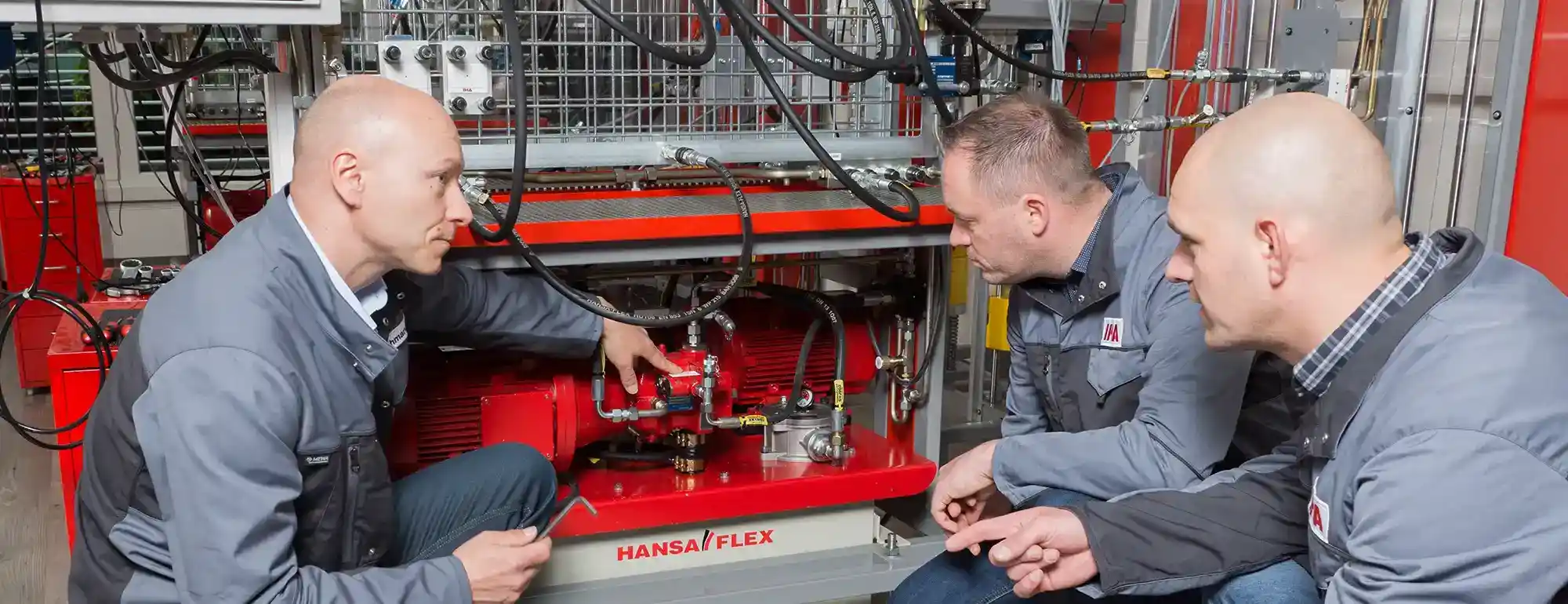
Whether in industry, construction, agriculture, aerospace or even leisure parks: hydraulics is now indispensable. Yet the discipline is missing from the list of recognised training occupations (those requiring formal training) and from college prospectuses. The officially recognised further training qualification “Hydraulics Specialist” offers to fill this gap. A conversation with Sandra Stemmler, Personnel Development Specialist at HANSA‑FLEX, and Ulrich Hielscher, Managing Director of the IHA.
Why is the Hydraulics Specialist qualification important to you?
Stemmler: Hydraulics is the DNA of our company. We have a great responsibility towards our employees, our customers and their hydraulic plants and machinery. Highly qualified employees are essential in order for us to fulfil this responsibility, and the further training qualification “Hydraulics Specialist” at the IHA provides exactly that.
Hielscher: In spite of its relevance for practically all industries, hydraulics still does not command its own place among the officially recognised occupations requiring formal training. With the further training qualification “Hydraulics Specialist” at the IHA, we provide the answer and offer an official qualification recognised by the Chamber of Crafts and Trades (HWK) with a requirements profile that is comparable with that of an industry professional.
What is the target group of the further training?
Stemmler: At HANSA‑FLEX, we place great value on the continuous professional development of our employees and are happy to draw on the extensive range of seminars offered by the IHA. Our employees can apply to attend these courses. We are also in regular touch with our managers, who let us know which of their team members are ready to become hydraulics specialists.
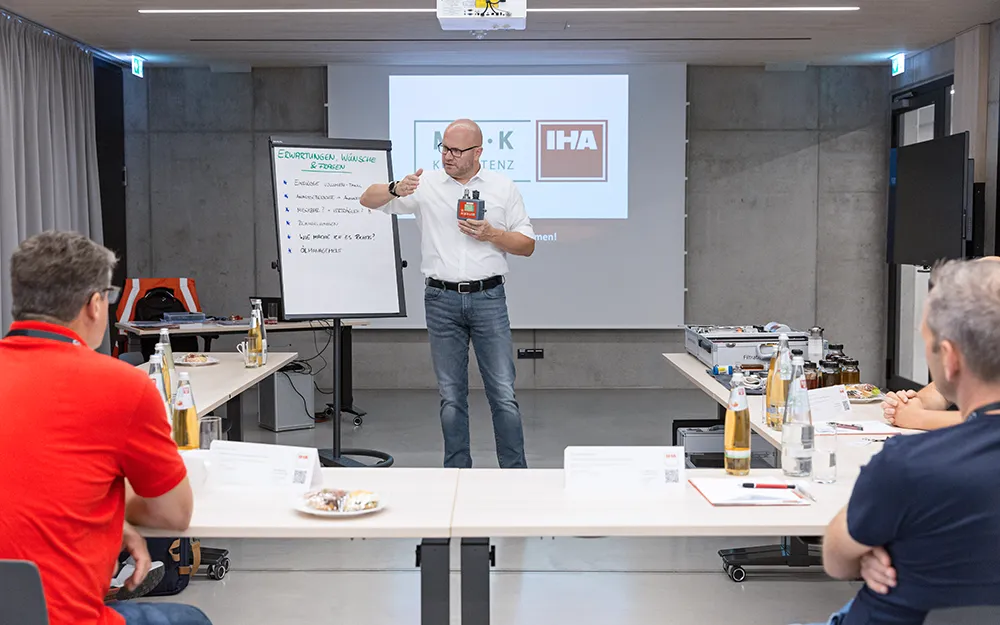
Hielscher: Most attendees come from customer services, equipment servicing and maintenance. However, customer advisers, product managers and technical sales staff are among the participants and benefit from the practical knowledge. The successful course attendees are then in the position to fulfil their day-to-day hydraulics-related roles in a competent and professional manner.
How long does the further training take?
Hielscher: Nine weeks spread out over one year. At the end waits the examination at the Dresden HWK and an officially recognised final qualification.
Stemmler: The course timetable looks good to me. After a week at the IHA in Dresden, our employees can then apply their knowledge in their everyday work and go over the course material at their own pace, while perhaps formulating a few questions.
What is actually included in the course programme?
Hielscher: Listing the whole of the course content here would take too long. We explain the physical and mathematical principles, differentiate between industrial and mobile hydraulics and, as you would expect, delve into sealing technology as well as the dimensioning and placement of hydraulic hose lines and pipelines. The programme covers various types of valves, pumps, motors and cylinders alongside proportional hydraulics, hydraulic oils and the principles of mobile hydraulics and control technology. This is complemented by the construction, function and design of pressure accumulators, troubleshooting with measuring instruments and the dimensioning of hydraulic systems. In addition to the theoretical principles, we place great value on practical exercises on the training benches.
Stemmler: Almost all hydraulic components must be correctly designed in order to achieve the correct balance of performance, reliability and safety. Some of the content of the further training course is complex and truly challenging. However, that is necessary simply because our customers need to be able to rely on us.
How does the IHA course differ from other training programs?
Hielscher: There are training providers who offer a compact course to become a certified hydraulics specialist in five weeks. These courses are in no way comparable with ours and do not comply with the requirements of the HWK, where the “Prüfungsordnung für Fortbildungsprüfungen” (Examination regulations for further training examinations) and the “besondere Rechtsvorschrift für die Fortbildungsprüfung zur Hydraulik-Fachkraft” (special legal provision for the further training examination to become a Hydraulics Specialist) must apply. We took the deliberate decision at the IHA to include topics such as pressure accumulators, troubleshooting, oils and mobile hydraulics in our course.
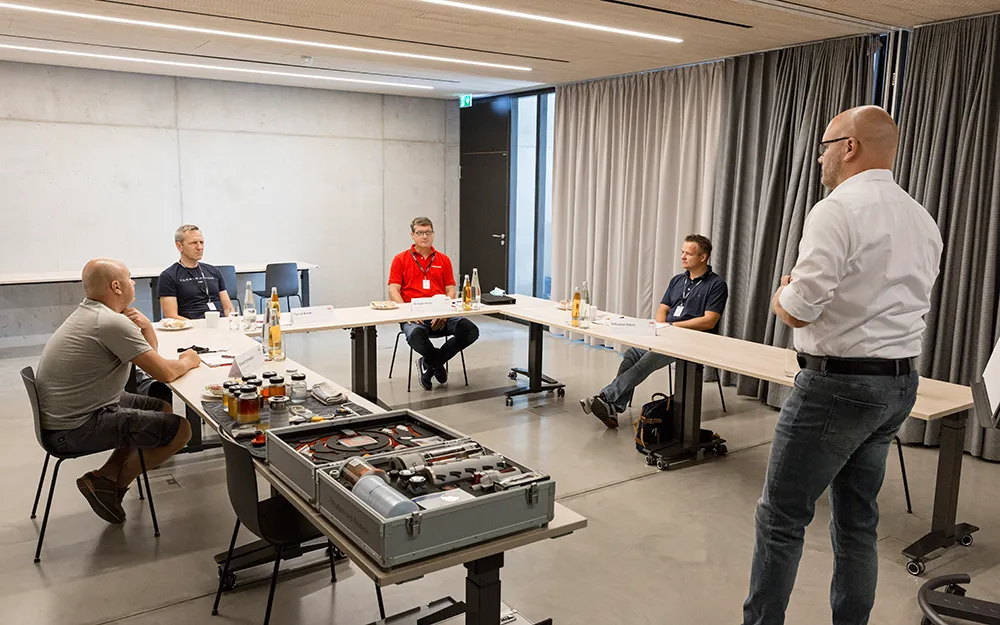
Stemmler: Many further training courses have a remote component. We place a high value on the practical side of further training. The exercises on the training and test benches are part of this practical element. This happens only in presential, i.e. face-to-face, learning situations.
Hielscher: We also have online content but always as additional course material. Complementary to face-to-face learning, we also offer online consultation sessions in the time between the course units, which are very popular, particularly before the examination.
What is the feedback like from the participants?
Hielscher: The further training is challenging and not everyone passes the final examination of the Dresden Chamber of Crafts and Trades. Whoever successfully completes the further training can rightfully be proud of themselves. We are always hearing how confident and self-assured people are in their careers afterwards.
Stemmler: That is a very important point. After their further training, we see how our employees are appreciated as real problem solvers and technical advisers by our customers.
Hielscher: We should say a little about the subject of networking. During and after the further training, the participants form a network, not only with each other but also with the course presenters. I have recently spoken with someone from the very first course at a trade fair. The course participants still meet once a year and are always on the phone to one another.
Stemmler: The value of networking should not be underestimated. When colleagues cannot solve the problem at hand, they know someone who they can ask.
What comes after further training?
Stemmler: When one of our staff successfully completes further training, they declare themselves ready to work for six to twelve months in an area in which they can put the knowledge gained into practice, for example in the Industrial Service. Undergoing further training is an important part of working at HANSA‑FLEX in departments such as the Fluid Service. Further training opens new doors within the company.
Hielscher: Successful participants can then specialise further and optimally align their knowledge with their current or future fields of activity. We also offer advanced seminars, for example on hydraulic line equipment, fluids or troubleshooting.
A final comment?
Hielscher: With the Hydraulics Specialist qualification, we have authored a genuine success story. However, it also highlights the need for hydraulics to be integrated much more prominently than before into traditional occupations that require formal training and courses of study. For this reason, we are also engaged in the Hydraulics Initiative, which addresses these specific goals.
Stemmler: We consider further training as an investment in the future. Our customers also benefit from the further professional development of our employees. Satisfied customers turn into returning customers, making this investment a win for the whole company.
-

Sandra Stemmler
Personnel Development Specialist at HANSA‑FLEX
-

Ulrich Hielscher
Managing Director of the IHA