Austria
 Belgium
 BosniaAndHerzegovina
 Bulgaria
 Croatia
 Czechia
 Estonia
 France
 Germany
 Hungary
 Ireland
 Italy
Italy
 Latvia
 Lithuania
 Luxembourg
 Netherlands
 Poland
 Portugal
 Romania
 Serbia
 Slovakia
 Slovenia
 Spain
Spain
 Swiss
Swiss
 Ukraine
 United Kingdom
 Australia
 China
China
 Georgia
 India
India
 Kazakhstan
 Singapore
 Thailand
 Turkey
 الإمارات العربيّة المتّحدة
 South Africa
 Canada
 Mexico
 USA
USA
 Brazil
 Chile
Chile
More than two thirds of industrial energy demand is used to generate process heat – and over 80 percent of this still comes from fossil fuels such as natural gas or oil. Heat pumps could change that: they are highly efficient and, when powered by green electricity, operate with virtually zero CO₂ emissions. Until now, however, they have had one decisive weakness. Most heat pumps provide heat only up to 150 degrees Celsius, while research facilities occasionally reach 200 degrees. That is not enough for paper drying, PVC production or food roasting, where temperatures of up to 300 degrees are required. This is precisely where the German Aerospace Center comes in.
Cobra: the name says it all
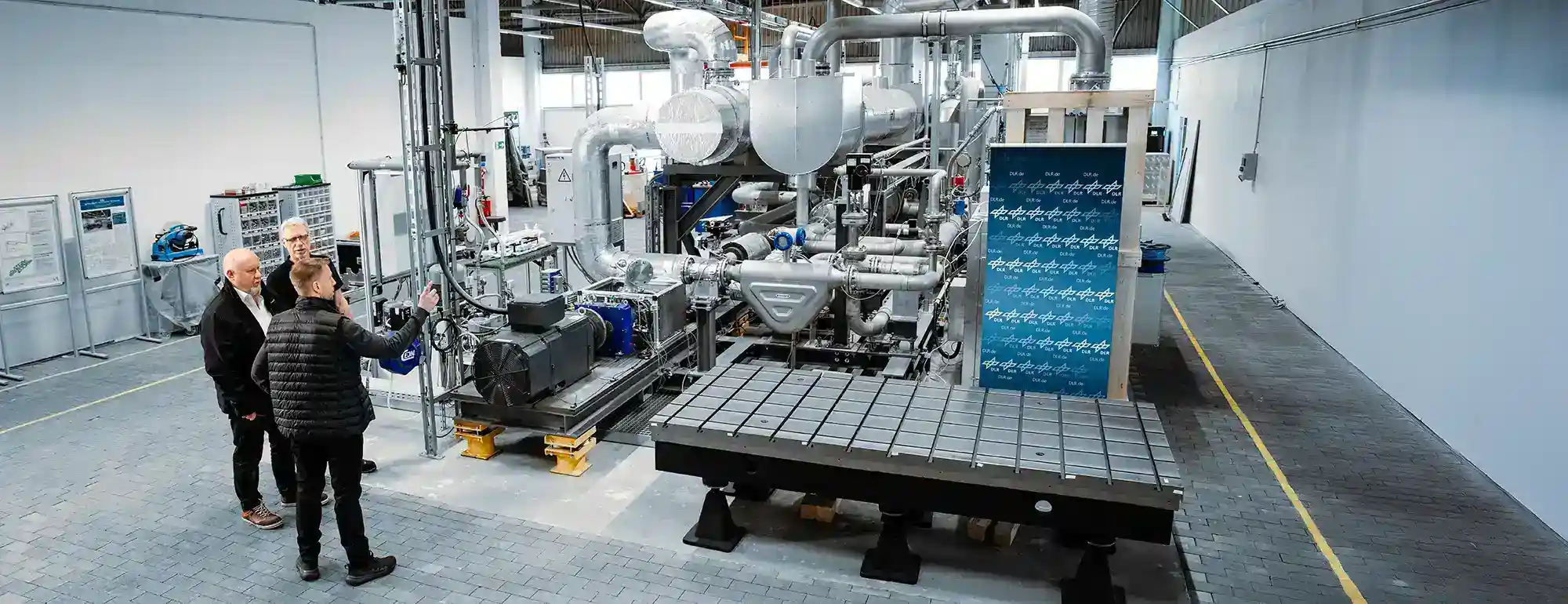
At DLR’s Cottbus site, the Institute of Low-Carbon Industrial Processes, founded in 2019, has developed a high-temperature heat pump designed to close this gap. The name “CoBra” refers both to the Cottbus location and to the thermodynamic Brayton process. In the Brayton process, air is compressed and heated in the process. The system then transfers this heat to an industrial process. CoBra supplies process heat of more than 300 degrees Celsius and, at the same time, process cooling down to minus 40 degrees, with a thermal output of around 200 kilowatts. “The CoBra test facility achieves temperature values that are unique worldwide. Until now, such high temperatures have not been possible with heat pumps in industrial use. Yet they are essential for the low-carbon transformation of the corresponding industrial processes,” explains Justus Herbrich, engineer and project manager at DLR in Cottbus.
The compressor and its need for lubrication
At the heart of CoBra is the compressor. Here, DLR relies on a powerful solution from shipbuilding: a type of turbocharger used to compress exhaust gases was adapted by DLR for use in the heat pump. “This applied-research approach – modifying proven components from other industries instead of developing new ones from scratch – saves both time and costs,” says Herbrich, explaining what may at first seem like an unusual approach. With a drive power of up to 100 kilowatts, the compressor runs at very high speeds, made possible by an upstream gearbox. This high-performance gearbox requires reliable, precisely metered lubrication with hydraulic oil – a task handled in CoBra by a hydraulic power unit.
From hose line to custom-built solution
“We came to know the HANSA‑FLEX Cottbus branch as a reliable supplier that impressed us with short response times and personal consulting,” Herbrich recalls. When DLR encountered a serious problem during the construction of CoBra, the hydraulics specialist was able to help. “We took a close look at the situation on site, analyzed the critical points and developed a concept that was truly tailored to the system,” says Uwe Fröhlich, account manager at HANSA‑FLEX and, at the time, directly involved in the project as technical advisor. “It was anything but a standard order – but it is exactly these kinds of challenges that drive us.”
Flexibility, research and operational reliability
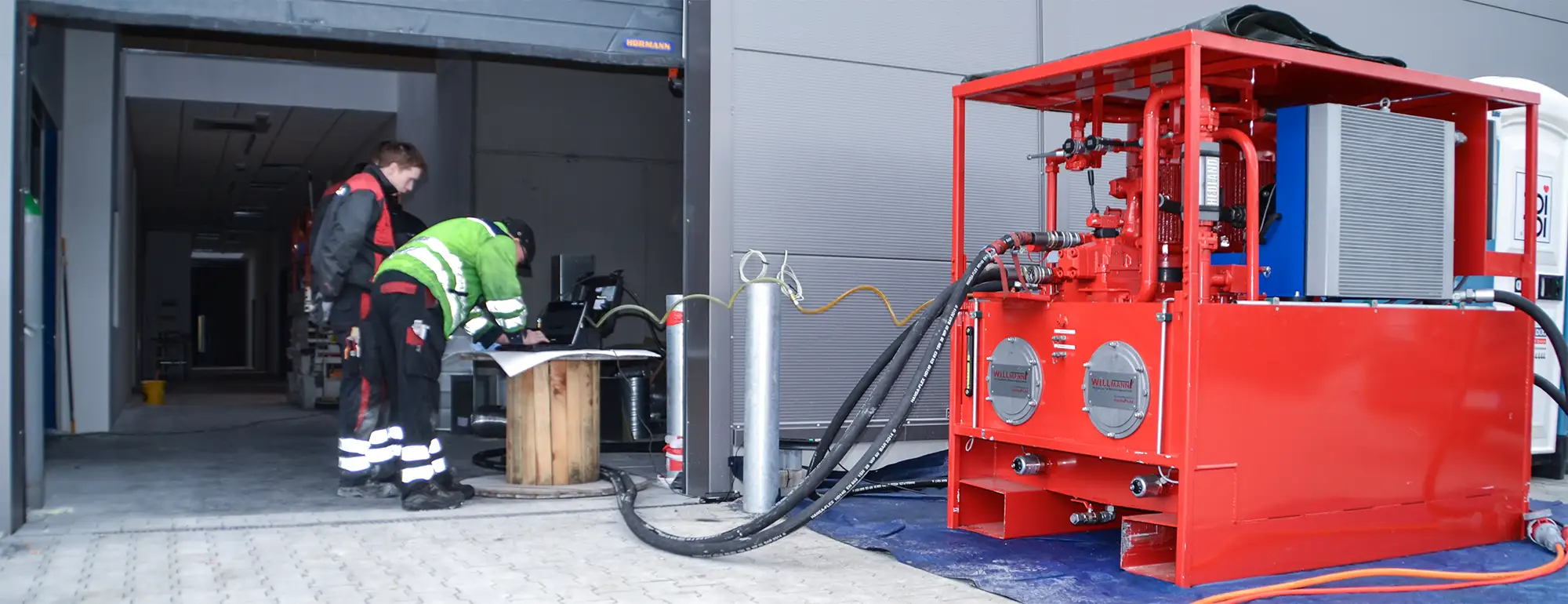
The result is a custom-built power unit manufactured individually for DLR, combining several requirements in a single solution. On the one hand, oil pressure, volume flow and temperature must be precisely matched to the respective operating mode of the heat pump. One particular challenge was the operating pressure: while pressures of 350 bar are common in hydraulics, the gearbox lubrication requires only 0.4 to a maximum of 3 bar, depending on the operating phase. “Precisely regulating such low pressures requires not only careful selection of the sensors and other components, but also a great deal of development expertise,” reports René Hohberger from the Technology/Development department at HANSA‑FLEX. In addition, the returning, heavily foaming oil must be reliably degassed before it re-enters the cooling and lubrication circuit. This also prevents measurement errors in the temperature-compensated volume-flow measurement. The designers were already familiar with managing specific space constraints from other projects.
On the other hand, DLR wanted a solution that could be controlled via the central control room while also being self-monitoring and easy to integrate quickly into the overall system. The power unit independently monitors all relevant parameters: temperature, pressure, oil level, speed, frequency converter, volume flow and filters. If a first limit value is exceeded, a warning is sent to the heat pump’s central control room; if a second limit value is exceeded, the compressor system is shut down via emergency stop to prevent damage to the expensive gearbox. All parameters can be finely adjusted via a dedicated control system with touch panel programmed by HANSA‑FLEX – a crucial prerequisite for research. “For us, it was essential that the power unit not only run reliably, but also enable us to conduct research in order to determine the optimum parameters for efficient heat pump operation. HANSA‑FLEX delivered a system that cleverly combines flexibility, research and system protection,” Herbrich explains.
Commissioning without surprises
Before the power unit was delivered to Cottbus, it underwent several optimization cycles in Dresden-Weixdorf: the software and control system were tested and refined. When DLR finally installed the power unit, everything worked from the very first moment. The HANSA‑FLEX technician who had already been scheduled for commissioning was not needed at all. During the first tests, an additional requirement emerged for starting up the gearbox. This was quickly implemented using another sensor from the standard product range. HANSA‑FLEX had anticipated this possibility and had already prepared for it in the design. “The fact that commissioning went so smoothly shows how carefully HANSA‑FLEX worked, from the initial requirements analysis through to the finished system. We had a reliable contractor who understood our requirements precisely,” says Herbrich.
Heat without emissions
The CoBra project impressively demonstrates that high-temperature heat pumps for industry are feasible. Three pilot projects in the paper, food and rubber industries – in Germany, Italy and Greece – are currently demonstrating the technology’s potential under real-world conditions. “The feedback from industry has been extremely positive. Our heat pump technology has the potential to save one quarter of total industrial CO₂ emissions,” emphasizes Justus Herbrich. For HANSA‑FLEX, the power unit was far more than just another order. The family-owned company is pursuing an ambitious sustainability strategy of its own, with the goal of becoming climate-neutral by 2040. “Our entire team is proud to be helping shape the energy transition with our engineering expertise and commitment,” concludes Uwe Fröhlich.