Austria
 Belgium
 BosniaAndHerzegovina
 Bulgaria
 Croatia
 Czechia
 Estonia
 France
 Germany
 Hungary
 Ireland
 Italy
Italy
 Latvia
 Lithuania
 Luxembourg
 Netherlands
 Poland
 Portugal
 Romania
 Serbia
 Slovakia
 Slovenia
 Spain
Spain
 Swiss
Swiss
 Ukraine
 United Kingdom
 Australia
 China
China
 Georgia
 India
India
 Kazakhstan
 Singapore
 Thailand
 Turkey
 الإمارات العربيّة المتّحدة
 South Africa
 Canada
 Mexico
 USA
USA
 Brazil
 Chile
Chile
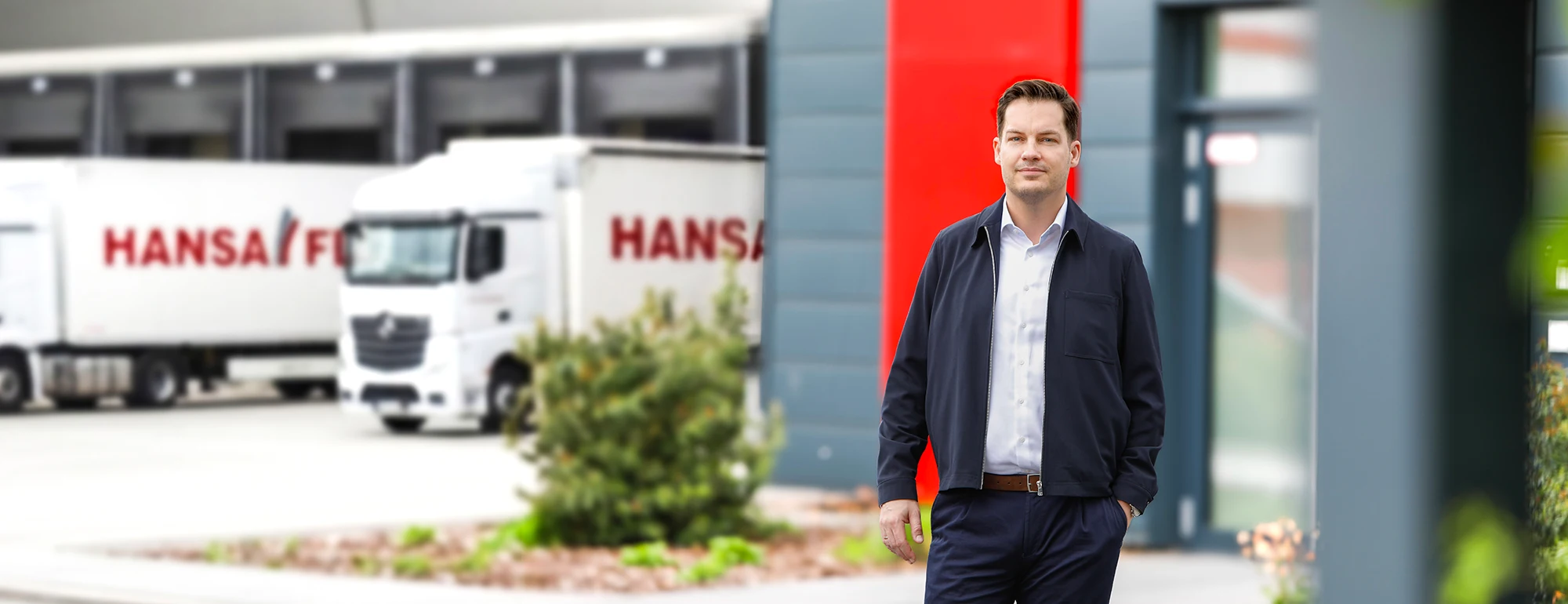
The right goods at the right time at the right place: processes all over the world have to coordinate seamlessly so that HANSA‑FLEX customers can be supplied quickly and reliably, day after day. In the interview, Maximilian Armerding explains why good logistics begins at the customer's premises, how new markets and purchasing habits demand new ways of doing things, and why logistics is a strategic success factor for HANSA‑FLEX.
What activities covers the Logistics and Global Trade division?
Our two central warehouses in Bremen and Geisenfeld play a key role. We concentrate a major part of our logistics activities there in order to supply our customers all over the world. We take into account the international orientation of HANSA‑FLEX with our Global Trade department. Our worldwide presence in 43 countries means the Import and Export sections, and the central warehouses are now inseparable. To these can be added two teams for logistics projects and software.
When you speak of customers, who are your actual customers?
We distinguish between internal and external customers. Internal customers are our production centres, branches and international subsidiaries who we supply with goods. External customers are the companies all over the world who rely on fluid technology from HANSA‑FLEX and are also supplied directly from our central warehouses. We who work in logistics therefore have to satisfy a remarkable range of different customer requirements. Our goal is always to offer the right solution for the customer.
How do you achieve this systemic customer orientation?
The crucial point for me is that we do not see logistics as an isolated company activity. At HANSA‑FLEX, we can be successful only by working as a team. In other words, in Logistics we work closely with other specialist departments such as Purchasing, Sales, Supply Chain Management and Quality Management. Moreover, it is not only about warehouse capacities and vendor standards but also about a holistic consideration of our processes from the customer’s point of view. In Logistics, we do not have direct contact with our end customers. In close dialogue with the company’s other specialist departments, we create solutions that model new customer requirements to the best possible extent.
In which areas are customer requirements changing today?
The number of orders that we receive through our online shop is continually increasing. These are typically small orders, usually just a few different items in low quantities. We have to design our processes in the central warehouse to allow us to efficiently pick not only full packaging units, i.e. cardboard boxes, but also individual items when we fulfil an order. By adopting optimised processes and consistent automation, we ensure that small-order quantities remain cost-effective to supply for us and for our customers. Something else: pre-picked kits consisting of several items. Our series production department in Bremen provides an example of an internal customer. Here we ensure that materials for production orders are supplied directly to the production floor. And last but not least, up-and-coming markets in the global context also demand a strategic expansion of logistics.
What’s happening with these strategic changes?
In addition to our over-the-counter sales in branches, we have been more strongly focused for some time now on the original equipment and series production businesses as well as new markets in Southeast Asia. The close cooperation of Logistics with the other specialist departments is indispensable in order to accommodate this growth. Working together in my team, we develop future-orientated logistics solutions with clear structures that allow scaling of our business. An example: if we increase the turnover rate, we can move more goods from the same warehouse stock levels and improve our cost effectiveness.
How will you make space for this growth?
We take two approaches. The first is a planned new central warehouse in Southeast Asia to deal with the growing demand from this region. We will achieve customer proximity and develop new suppliers in this region, always making sure, of course, that we adhere to the HANSA‑FLEX quality standards, which apply worldwide. At the same time, this will enable us to strengthen our global supply chains. The second approach is a continuous, customer-orientated auditing of our processes and their suitability when faced with new conditions.en.
What are the actual starting points for process optimisation?
An important lever for improving efficiency and transparency in Logistics is the consistent use of logistics data. All the decisions we make are, in the end, based on data. It is our task to collate the information already available from the various specialist departments and to add to it where necessary. The use of artificial intelligence can help us recognise patterns in these enormous quantities of data and identify starting points for developing our logistics solutions in a customer-orientated direction.
What topics are currently on your agenda?
With our motivated team and rapid, stable processes, we already have a very good foundation from which to build. Our customers all over the world appreciate our ability to supply goods with short delivery times. That does not necessarily mean that we cannot make the good even better. A focus for me is the modernisation of the two existing central warehouses in Germany. We have our own team who develop our logistics software and can therefore make any adjustments to our processes quickly and flexibly. It is not only about having efficient structures, it is also about the use of lighter, more energy-efficient technologies. Another example of more efficiency through transparency is digital, paperless processes in Incoming Goods. The central warehouses have already been reorganised, while the introduction of scanners in the branches and production areas opens significant potential for us to improve logistics here as well. New solutions like these are developed by our Logistics Projects department, which operates separately from our daily business.
What roles do you see for Logistics at HANSA‑FLEX in the future?
Logistics already makes an important contribution to the success of our company today. This is also evident by HANSA‑FLEX recently making Logistics into an independent division within the company. By centralising our activities and defining company-wide standard processes, we aim to sustainably boost our logistics performance. Adopting scalable standard solutions instead of taking an individual bespoke approach allows us to make better use of our resources and guide the further development of the entire company. As Head of Logistics and Global Trade, I am naturally very much involved with questions about the future: What directions should we take today to ensure we are optimally set up in the future? These questions engage the whole company and I find dialogue with my colleagues about this very enriching.