Austria
 Belgium
 BosniaAndHerzegovina
 Bulgaria
 Croatia
 Czechia
 Estonia
 France
 Germany
 Hungary
 Ireland
 Italy
Italy
 Latvia
 Lithuania
 Luxembourg
 Netherlands
 Poland
 Portugal
 Romania
 Serbia
 Slovakia
 Slovenia
 Spain
Spain
 Swiss
Swiss
 Ukraine
 United Kingdom
 Australia
 China
China
 Georgia
 India
India
 Kazakhstan
 Singapore
 Thailand
 Turkey
 الإمارات العربيّة المتّحدة
 South Africa
 Canada
 Mexico
 USA
USA
 Brazil
 Chile
Chile
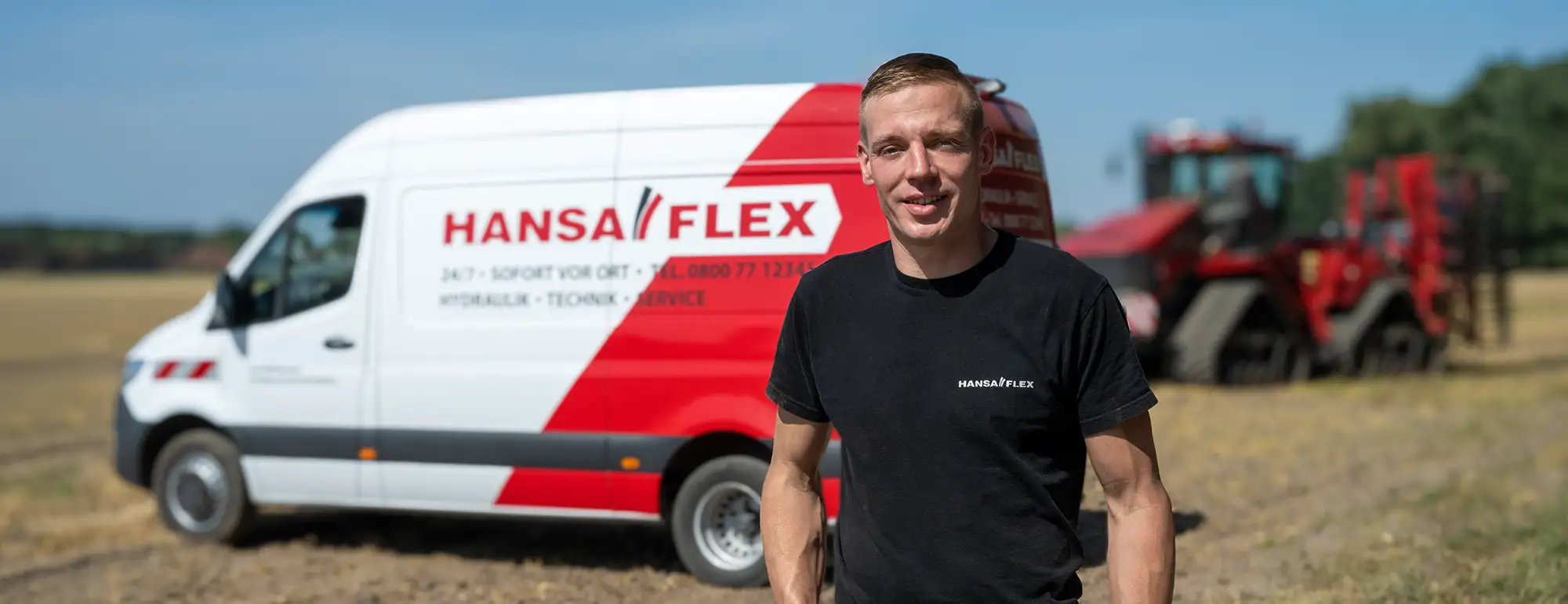
In the interview, the qualified agricultural machinery mechanic talks about easily disrupted harvest processing chains, night-time call-outs and the freedom felt when driving a tractor.
Timo, what brought you to the mobile Rapid Hydraulic Service?
Someone I’d known for years, who later became my supervisor at HANSA-FLEX, was looking for new staff and happened to mention it to me. I spent a day on the road with the mobile Rapid Hydraulic Service and was immediately filled with enthusiasm.
What had inspired you so much?
Without a doubt, the diversity. Every day is different, every day brings new insights into all sorts of industries. It is simply exciting and most enriching.
What qualities do you need for this job?
Technical knowledge, first of all. You must be able to quickly think your way into machinery or plant in order to correctly understand the problem. Then you have to find a solution that you can implement with whatever you have to hand in the service vehicle. This calls for plenty of flexibility and improvisation skills, always in compliance with all the standards and regulations. When the customer’s hydraulics stop working on site, there is often no time to drive to the nearest HANSA-FLEX branch to obtain a particular part.
What else is important?
Communication. As service technicians, we are always called when there is a problem anywhere. You have to be able to approach people, speak with them openly and sometimes bring calm to a situation on site.
What is your background?
I completed an apprenticeship to become an agricultural machinery mechanic and later worked for a company that deploys directional drilling equipment worldwide.
Who can you count among your customers?
I am on the road in the Braunschweig-Hanover conurbation and visit a wide range of customers, from traditional industrial companies and steelworks to building sites and inland waterway shipping operators. I also cover rather more rural areas and work for many agricultural customers.
How does the agriculture sector differ from other industries?
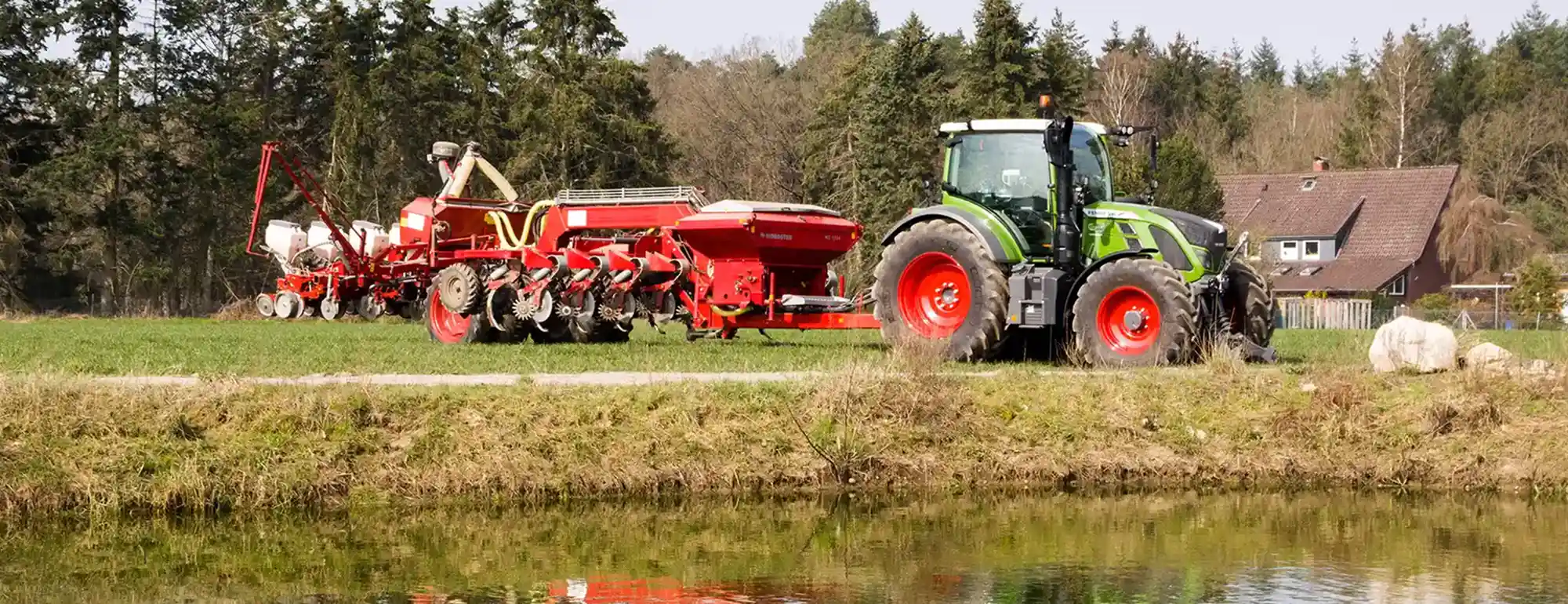
On the one hand, there is an enormous variety of machines and vehicles. From tractors, front and yard loaders to specialist trailers such as balers and sugar beet harvesters. Then you have the insanely complex mechanical giants such as combine harvesters or forestry harvesting machines. More than a few farmers design their own machinery, some of which is quite tricky to work on. On the other hand, the action seldom takes place in the farmyard but more frequently outdoors on some field in the fresh air.
Does your mobile phone often ring during the night?
In the mobile Rapid Hydraulic Service, we take it in turns to be on-call. Many of our customers work 24/7, therefore it is inevitable that we also must turn out in the middle of the night. Farmers go by the weather during harvesting, not the clock.
How do you find the right field in these situations?
Obviously, satnav often shows its limitations here. Fields do not have an actual address such as “108 The Meadows”. In my home patch, I know almost every field track, which is a real advantage. Alternatively, the customer simply gives his GPS location.
Where do you keep your service vehicle in the evening?
In front of the house door. This has already brought in more than an order or two. People see the vehicle and approach me directly. Time and time again, my house phone rings and a complete stranger says to me, “Hello, I got your number from a farmer friend of mine. My tractor has packed up, when can you get here?”
How do you answer?
I ask where the tractor is. An order is created and off I go. It is a great feeling to know that people trust us absolutely, especially at times when every minute counts for us in the countryside.
Why is time so important in agriculture?
Today, many harvesting chains are at work during the harvest. These chains consist of several agricultural machines, working hand-in-hand with one another. Tractors and trailers follow closely behind combine harvesters, taking away the grain directly. It takes only one tractor or other agricultural machine to break down for the whole harvesting chain to come to a standstill.
What has been your most extraordinary task?
Difficult to say, I have experienced so much in all the various industries. That is certainly one of the best things about my job. Off the top of my head, I’d say it was one call-out to an inland waterway vessel. During the repair of an engine, the teams on the bridge and in the engine room were communicating by radio. Another ship’s crew thought it would be funny to join in the radio messages. The engine was started at the wrong time and a large tool became jammed in it. HANSA-FLEX was called, and the first thing I had to do was to cut through the stuck object with a portable power tool and pull it out. After this, the ship could move again.
What do you do after work?
Drive tractors! No joke. I help a friend who works in agriculture. The view across the fields is a piece of freedom for me. Working on the land is so much fun that I have made a mini-job out of it. And during the harvest, every helping hand is welcome.
What other hobbies do you have?
We do a lot of things together, me, my partner and our dog. I have also been active in the Volunteer Fire Brigade for many years. People who work in the Rapid Hydraulics Service are natural problem solvers, a skill which transfers automatically into their private lives: assess the situation, weigh up alternatives, address the challenge. Whether in the Fire Brigade vehicle or service van, it makes no difference.
Would you swap your job for one in the office or production?
No way! From time to time, a customer looking for staff will ask. Then I always say that you could not lock me up under the “Neon Sun” all day – it would not work.